Tea to Water Ratio Chart
Published How we research
Leaf quantity matters as much as steep time and water temperature, and because tea leaves vary enormously in density, a teaspoon of fluffy white tea and a teaspoon of tightly rolled oolong can differ by a factor of three in actual weight. This chart gives both weight and volume starting points by tea type, for Western-style brewing and for the much higher leaf ratios used in gongfu brewing.
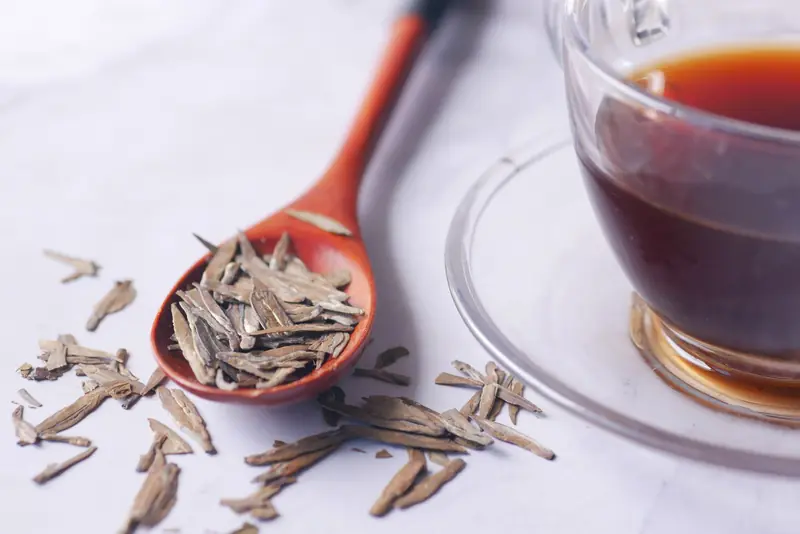
Western brewing: grams per 8oz (240ml) cup
Black tea: 2-3 grams, roughly 1 level teaspoon. The standard reference ratio most tea packaging is written around.
Green tea: 2-3 grams, roughly 1 teaspoon. Japanese greens like sencha are often used slightly heavier at 3-4 grams with a shorter steep.
White tea: 2-3 grams by weight, but often 1.5-2 heaped teaspoons by volume, since whole white tea leaves are very light and fluffy relative to their weight.
Oolong: 3-4 grams, roughly 1 to 1.5 teaspoons for rolled oolongs, which are dense and expand dramatically once wet.
Pu-erh: 3-5 grams, broken from a cake or loose. Ripe pu-erh is usually brewed heavier than most other teas even Western style.
Herbal tisanes: 2-4 grams, often 1-2 heaped teaspoons, since dried flowers and leaves like chamomile and peppermint are extremely light for their volume.
Why weight beats teaspoons
A teaspoon is a volume measure, so it holds wildly different amounts of tea depending on leaf shape: a teaspoon of tightly rolled gunpowder green weighs far more than a teaspoon of fluffy silver needle white tea, even though both are nominally 'one teaspoon'. This is the single biggest reason two people following the same recipe get different-strength cups.
A small kitchen scale reading in 0.1 gram increments removes the guesswork entirely and costs very little. Once you know your preferred grams-per-cup for a specific tea, that number stays reliable across every batch, unlike a spoon measure.
Gongfu brewing uses far more leaf
Gongfu-style brewing inverts the Western ratio, using roughly 5-8 grams of leaf per 100ml of water, which is around five times more leaf per unit of water than a Western cup. The tradeoff is time: steeps last seconds rather than minutes, and one portion of leaf yields many infusions instead of one.
A common gongfu starting point is filling a 100-150ml gaiwan about one third full with dry rolled oolong, or covering the bottom with a single layer for open leaf teas, then adjusting after the first session based on how the tea tastes.
Adjusting from the starting ratio
If your tea tastes weak but not bitter, add leaf rather than extending the steep, since a longer steep on too little leaf pulls out tannins and astringency without adding much body. If it tastes strong and harsh, cut the steep time first and only then reduce the leaf.
Water hardness, cup size, and personal taste all shift the ideal ratio, so treat these numbers as a calibrated starting point rather than a target. Write down what works for each tea you own and you will stop guessing entirely.
Popular right now
- Best Tea Storage TinsBuying guide
- Descaling a KettleArticle
- Tea-to-water ratio explainedGlossary
- Best Electric Tea KettlesBuying guide
- Best Glass Electric KettlesBuying guide
- Best Matcha Bowls: Chawan Picks for WhiskingBuying guide
Based on the last 28 days of search and visitor data.